
Lymphatic filariasis is a human disease caused by parasitic worms known as filarial worms.
Reference https://en.wikipedia.org/wiki/Lymphatic_filariasis
Dr Susan Grace has rife and protein peptide frequencies transmitted in remote mode to eliminate all the parasites and bacteria noted in this article. More info at the end of the article.
Usually acquired in childhood, it is a leading cause of permanent disability worldwide, impacting over a hundred million people and manifesting itself in a variety of severe clinical pathologies. While most cases have no symptoms, some people develop a syndrome called elephantiasis, which is marked by severe swelling in the arms, legs, breasts, or genitals. The skin may become thicker as well, and the condition may become painful. Affected people are often unable to work and are often shunned or rejected by others because of their disfigurement and disability.
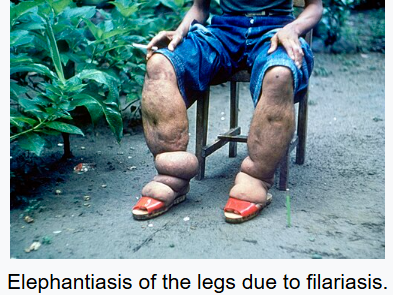
It is the first mosquito-borne disease directly linked to mosquitoes. The worms are spread by the bites of infected mosquitoes. Three types of worms are known to cause the disease: Wuchereria bancrofti, Brugia malayi, and Brugia timori, with Wuchereria bancrofti being the most common. These worms damage the lymphatic system by nesting within the lymphatic vessels and disrupting the system’s normal function. Worms can survive within the human body for up to 8 years, all while reproducing millions of larvae which circulate through the blood.
The disease is diagnosed by microscopic examination of blood collected during the night. The blood is typically examined as a smear after being stained with Giemsa stain. Testing the blood for antibodies against the disease may also permit diagnosis. Other roundworms from the same family are responsible for river blindness.
As of 2022, about 40 million people were infected, and about 863 million people were at risk of the disease in 47 countries. It is most common in tropical Africa and Asia.
Lymphatic filariasis is classified as a neglected tropical disease and one of the four main worm infections. The impact of the disease results in economic losses of billions of US dollars a year.
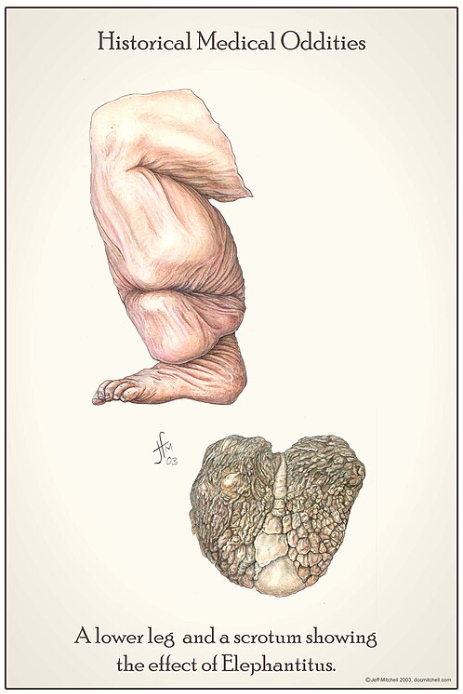
Image drawn from the collection at the National Museum of Health and Medicine and shows the effect of elephantiasis in an historic context.
Signs and symptoms
Most people infected with the worms that cause lymphatic filariasis never develop symptoms; though some have damage to lymph vessels that can be detected by medical ultrasound. Months to years after the initial infection, the worms die, triggering an immune response that manifests with repeated episodes of fever and painful swelling over the nearest lymph nodes (typically those along the groin). In areas with endemic lymphatic filariasis, people are typically infected in childhood, and symptoms begin in adolescence.
A subset of those affected have continued damage to their lymph vessels. Dysfunctional vessels fail to recirculate lymph fluid, which can pool (called lymphodema) in the nearest extremity – generally the arm, leg, breast, or scrotum. Loss of lymph function (which transports immune cells) results in various repeated infections in the area. Repeated cycles of infection, inflammation, and lymph vessel damage over several years cause the affected extremity to swell to an extremely large size. The surrounding skin thickens, becoming dry, discoloured, and dotted with wartlike lumps that contain tortuous loops of lymph vessels.
Even those without lymph damage can sometimes develop an allergic reaction to the worm larvae in the capillaries of the lung, called tropical pulmonary eosinophilia. These people develop nocturnal coughing, fatigue, and weight loss. Over time, this can damage the lungs, resulting in restrictive lung disease (decreased lung capacity).
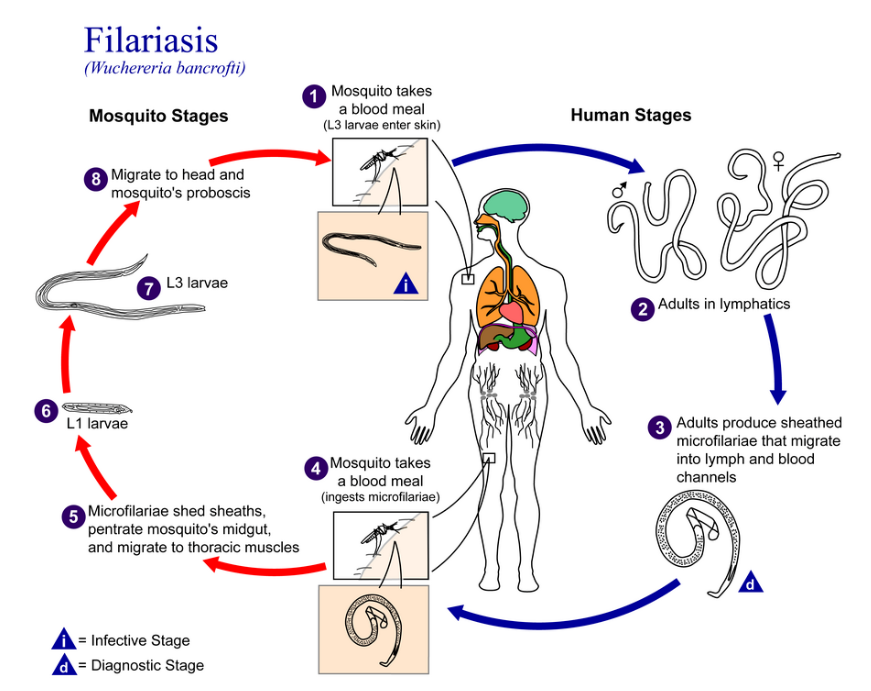
The image shows the life cycle of Wuchereria bancrofti, a parasite that causes lymphatic filariasis.
Lymphatic filariasis is caused by infection with three different nematode worms:
Wuchereria bancrofti (causes 90% of cases), Brugia malayi, and Brugia timori.
The three worms are transmitted by the bite of an infected mosquito – largely of genera Aedes, Anopheles, Culex, or Mansonia. When the mosquito bites, infectious nematode larvae are dropped onto the skin. They crawl into the bite wound, through the subcutaneous tissue, and into nearby lymph vessels. There, they develop into adults over about a year, with adult females up to 10 centimetres (3.9 in) long, and males up to half that length. Adult females and males mate, prompting the female to begin releasing a constant stream of larvae called “microfilariae” – more than 10,000 microfilariae each day for the adult’s remaining lifespan of around five to eight years. Microfilariae typically circulate in the blood stream at night; during the day they collect in the capillaries of the lungs.
A mosquito that feeds on an infected person can take up microfilariae along with its blood meal. Inside the mosquito, the microfilariae pierce the stomach wall and crawl to the flight muscles, where they mature over 10 to 20 days into their human-infectious form. They then crawl to the mosquito’s mouth to be deposited at its next bite, continuing the lifecycle.
The disease itself is a result of a complex interplay between several factors: the worm, the endosymbiotic Wolbachia bacteria within the worm, the host’s immune response, and the numerous opportunistic infections and disorders that arise. The adult worms live in the human lymphatic system and obstruct the flow of lymph throughout the body; this results in chronic lymphedema, most often noted in the lower torso (typically in the legs and genitals). These worms can survive within the human body for up to 8 years, all while reproducing millions of larvae which circulate through the blood.
What frequency technology does Dr Susan Grace use?
Dr Susan Grace uses the latest technology of the Spooky2GX Pro Rife machine. The Spooky2 rife machine was developed over many years by the founder of John white and an international team of electronics engineers, technical designers, software developers and Rife practitioners. All determined to eliminate disease. This is the most highly advanced and versatile Rife machine in the world and has the largest software database in the world, and it continues to grow.
The remote mode is used to deliver scalar frequency treatments.
Remote treatments can fit perfectly into your busy lifestyle. When you’re using remote mode treatments you don’t have to be in the same room or in the same country. Only your DNA such as a finger nail clipping is needed in the treatments. It sounds like something out of Star Trek, but it’s real science, and it works astonishingly well.
The Remote mode with the Spooky2 rife device applies frequencies at any distance using the recipient’s DNA to treat people. It uses the principles of quantum physics and the antenna properties of DNA to transmit through nonlocal space.
Modern physicists named it “Quantum Entanglement.” To put it simply, it means that if any part of a single system is removed from that system to a different location, any action performed on the part will also be instantaneously performed on the parent system and vice versa.
Remote mode can be used to deliver Peptide presets.
I help people with any human condition including chronic long term health issues who are receiving no results from their current treatment modalities. I help to overcome their issues.
Peptide Presets – A New Wellness and Healing Era for any Human Condition.
Available over 2,000 human conditions that I can possibly help you with.
Find out more about Peptide presets
Find out how the Wellness Frequency Programs work – created by Dr Susan Grace.
The services Dr Susan Grace offers are intended to support general wellbeing and are not a substitute for professional medical diagnosis or treatment.